Honeymoon Duration Estimator
Not sure how long to book? Answer a few questions to find your ideal trip length.
Recommended Honeymoon Length
Days Total
Activity Breakdown
- Travel/Transit: days
- Recovery Buffer: days
- Core Experience: days
PTO Optimization Tip
You just got engaged. The ring is on your finger, the venue is booked, and suddenly everyone wants to know where you are going for your honeymoon. But before you book flights to Bali or Paris, there is a quieter, more critical question that often gets overlooked: how long should this trip actually be?
It’s not just about budget-though that matters-it’s about energy, burnout, and the reality of modern work schedules. I’ve planned trips for couples who rushed off after three days of wedding chaos and ended up exhausted by day four. I’ve also seen people take two weeks and spend half of it adjusting to jet lag. There is no single magic number, but there is a formula that works for most people. It depends entirely on what kind of travelers you are and where you are heading.
| Traveler Type | Recommended Duration | Best For | Risk Factor |
|---|---|---|---|
| The Burned-Out Couple | 7-10 Days | Domestic getaways, short-haul international | Feeling rushed if distance is far |
| The Classic Explorer | 10-14 Days | Europe, Southeast Asia, Caribbean | Budget creep; missing work deadlines |
| The Deep Diver | 14-21 Days | Multi-country trips, safaris, remote islands | High cost; significant time off work |
| The Minimalist | 3-5 Days | Weekend escapes, nearby beaches | Post-wedding crash; feels like a fluke |
The Three-Day Rule (And Why It Rarely Works)
Many couples think they can squeeze a romantic getaway into a long weekend. Here is the hard truth: travel fatigue is real. If you fly six hours, you lose a full day to transit, security lines, and settling in. By the time you unpack, you have maybe two full days left. That is not a honeymoon; that is a stress test.
For any destination requiring a flight over four hours, aim for at least seven days. This gives you one day to arrive and decompress, five days of actual activity or relaxation, and one day to pack and return. Anything less leaves you feeling like you barely left home.
Matching Duration to Destination Type
Not all places need the same amount of time. A city break in London needs different pacing than a resort stay in the Maldives. Let’s break down the common scenarios.
Beach Resorts and Islands
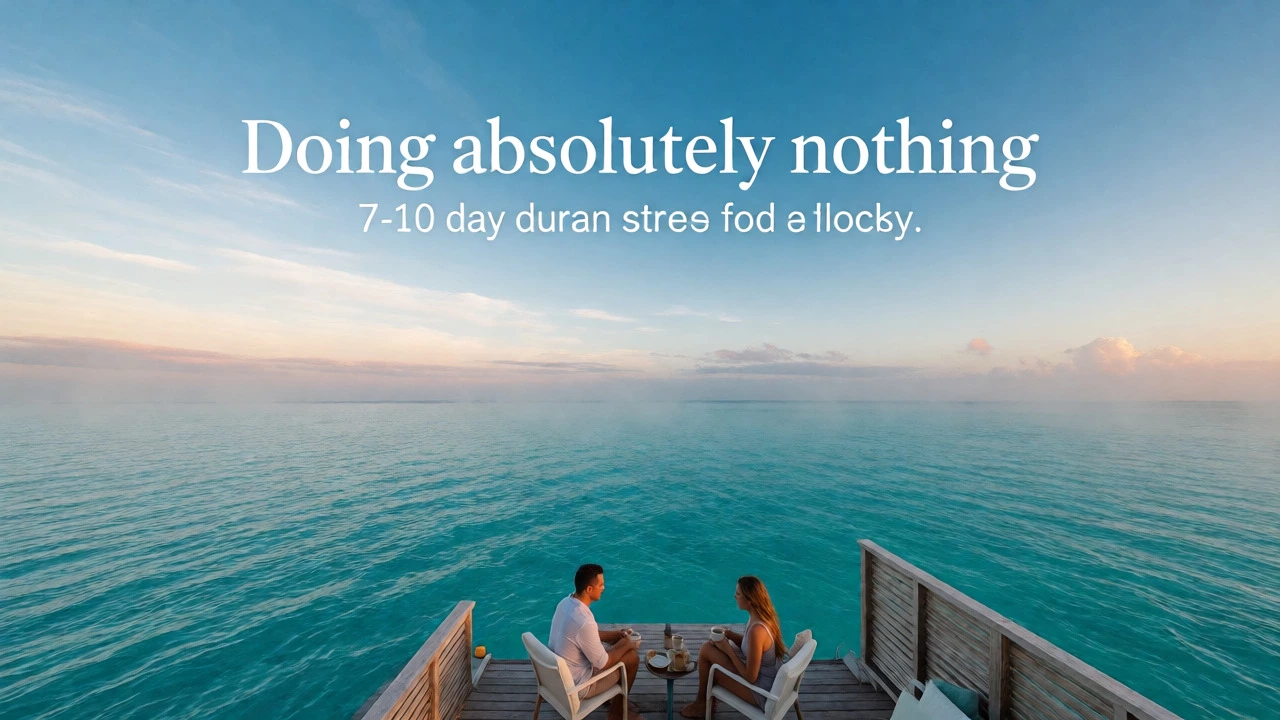
If your idea of romance is doing absolutely nothing, you might think you can do it in four days. But true relaxation takes time. Your brain needs at least 48 hours to switch from "wedding planner mode" to "vacation mode."
- The Maldives or Bora Bora: Aim for 7-10 days. These places are isolated. Getting there takes effort. Once you are there, you don’t want to leave too soon because the transition back to reality is harsh.
- Hawaii or Fiji: 10 days is the sweet spot. You have enough time to visit multiple islands without rushing, but you won’t go stir-crazy staying in one spot.
City Breaks and Cultural Tours
Cities like Paris, Tokyo, or New York are dense with things to see. Trying to see everything in three days leads to argument-inducing exhaustion.
For major cities, 5-7 days allows you to pick three key neighborhoods per day and still have time for a long dinner. If you are combining cities, say Paris and Rome, add 2-3 days per additional city for travel time. Do not underestimate train rides between European capitals; they eat up half a day.
Adventure and Remote Locations
Trips involving hiking, safari, or remote lodges require buffer time. Weather delays happen. Flights to small airports are often unreliable.
- Safari in Tanzania: Minimum 10 days. You need time for game drives, which start early and end late. Fatigue sets in quickly.
- Iceland Ring Road: 10-14 days. Driving conditions change rapidly. Rushing through waterfalls means you miss the experience.
The Post-Wedding Hangover Factor
This is the variable nobody talks about. After months of planning, your body is tired. Even if you feel energized on the wedding night, the next two days are usually a blur.
If you leave immediately after the wedding, build in a "do nothing" day upon arrival. Don’t schedule activities for Day 1 or 2. Use them to sleep, swim, or stare at the ocean. If you skip this buffer, you will likely spend your expensive honeymoon napping instead of exploring. Add two extra days to your itinerary specifically for recovery.
Work and Budget Constraints
Let’s look at the practical side. Most jobs offer limited paid time off (PTO). In Australia, for example, standard annual leave might be four weeks. Using two weeks for a honeymoon is a big ask. Can you stretch it?
Combine weekends. Taking Thursday and Friday off plus Saturday and Sunday gives you four consecutive days. Add Monday and Tuesday, and you have eight days off work for only four days of PTO used. This trick makes longer trips financially viable for many young couples.
Budget-wise, remember that costs don’t scale linearly. Ten days isn’t twice as expensive as five days. Flights are fixed. Hotels often offer weekly discounts. Extending a trip by three days might only increase total cost by 15%, but it increases enjoyment significantly.
Signs You Need More Time Than Planned
If you find yourself asking these questions, extend your trip:
- Are we flying more than 8 hours one way?
- Is our visa process complex or slow?
- Do we plan to move between three or more locations?
- Has either partner had a high-stress year at work?
If you checked yes to two or more, add three days to your original plan. It is better to wish you stayed longer than to regret leaving early.

Real-World Examples
Consider Sarah and Mark from Brisbane. They wanted to visit Thailand. Initially, they booked 6 days. They realized Bangkok traffic alone would waste half their mornings. They extended to 9 days. They spent 3 days in Bangkok, flew to Chiang Mai for 3 days, and finished with 3 beach days in Krabi. The extra time allowed them to enjoy each place rather than just passing through.
Contrast this with Jen and Dave, who took a 4-day trip to Las Vegas. They loved it, but they admitted they felt guilty checking emails constantly because they knew they had to be back at work in 96 hours. Short trips work best when they are truly local or very close.
How to Decide: A Quick Checklist
Before booking, run this mental simulation:
- Calculate Travel Time: Multiply flight time by 2, then add 4 hours for airport processes. Subtract this from your total days.
- Assess Energy Levels: Are you running on fumes? If yes, subtract 2 days of activity and replace with rest.
- Check Visa Requirements: If visas take weeks to process, ensure your dates allow for processing delays.
- Consult Your Boss: Be honest about return dates. Uncertainty causes stress.
There is no shame in a shorter honeymoon if it fits your life. A well-rested couple enjoying a 5-day trip beats an exhausted couple struggling through a 14-day ordeal. Listen to your bodies, respect your budgets, and choose the length that lets you actually enjoy being together.
Is 7 days enough for a honeymoon?
Yes, 7 days is sufficient for domestic trips or short-haul international destinations (under 6 hours flight). It allows for arrival, 4-5 full days of enjoyment, and departure. However, for long-haul flights, 7 days may feel rushed due to travel fatigue and jet lag.
What is the average length of a honeymoon?
The global average varies, but in Western countries, it typically ranges from 7 to 10 days. In regions with longer statutory holidays, such as parts of Europe or Latin America, averages can reach 14 days. The trend is shifting toward shorter, more frequent trips rather than one massive expedition.
Should we wait after the wedding to leave?
Ideally, wait 1-2 days. This allows you to handle immediate post-wedding logistics, recover from alcohol consumption, and mentally shift gears. Leaving immediately often results in spending the first two days of the honeymoon sleeping or dealing with residual stress.
Does a longer honeymoon cost more?
Not proportionally. Fixed costs like flights remain the same. Accommodation often has weekly rates that lower the daily average. Food and activities are the main variable costs. Extending a trip by 3-4 days usually adds less to the total budget than doubling the flight cost would.
What if we have limited time off work?
Choose a closer destination. A 5-day trip to a nearby beach or city is better than a 10-day trip across the world where you spend 4 days traveling. Maximize quality time over quantity of miles traveled. Use weekends strategically to extend the trip without using excessive PTO.