India Travel Budget Calculator
Calculate your US dollar budget needs for India travel based on daily rupee costs and exchange rates. The article states budget travelers need 2,500-3,500 INR per day ($30-$42 USD).
Your Budget Summary
Based on article recommendationsTotal INR needed:
Equivalent USD:
Recommended USD to carry:
Most travelers ask this question before landing in India: Can you use US dollars in India? The short answer? No-not really. You can’t walk into a street food stall, hop on a local train, or pay for a temple entry ticket with a crisp $20 bill. India runs on the Indian Rupee (INR), and that’s not changing anytime soon. But that doesn’t mean your US dollars are useless. They’re just not the currency you’ll hand over at the counter.
Why US dollars won’t work at local shops
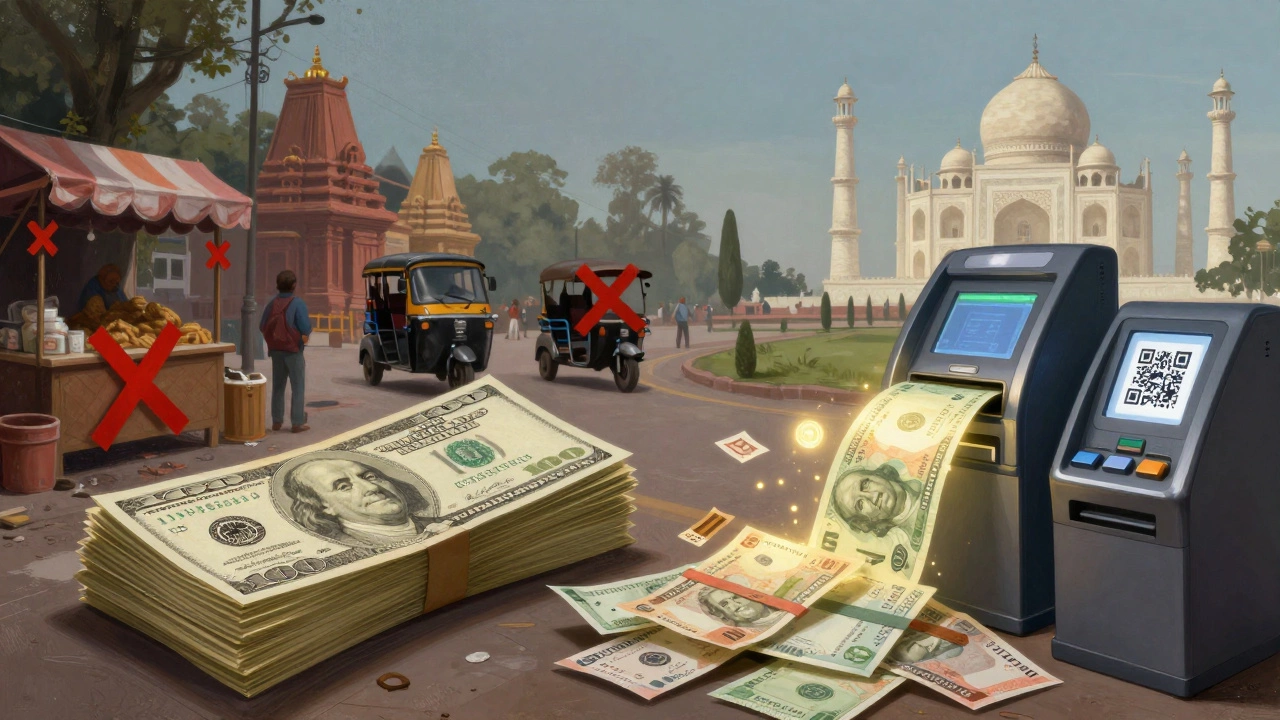
Indian businesses, big and small, don’t accept foreign currency for everyday transactions. Not the chai wallah on the corner. Not the rickshaw driver waiting at the station. Not even the souvenir shop near the Taj Mahal. Why? Because it’s illegal under India’s foreign exchange rules. Only authorized banks and forex counters can legally exchange dollars into rupees. Everyone else? They’re not set up to handle it. Even if someone says they’ll take dollars, they’re likely just trying to rip you off with a terrible exchange rate.Back in 2016, after India’s demonetization drive, the government cracked down even harder on unofficial currency exchanges. Since then, businesses that accept foreign cash face fines, and tourists who try to pay with dollars often get stuck with a bad deal or no deal at all. Don’t risk it. Save your dollars for the right moment.
Where you CAN use US dollars in India
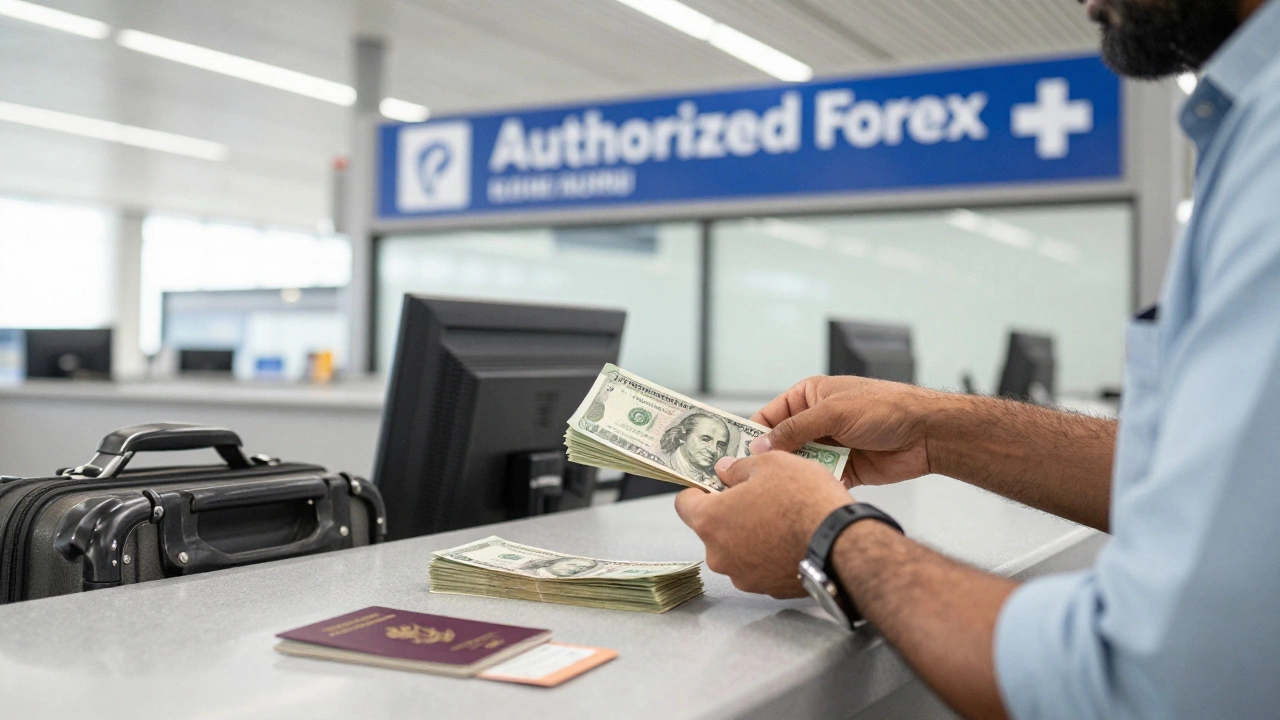
There are a few exceptions. High-end hotels in cities like Mumbai, Delhi, or Goa sometimes list prices in USD for international guests-but you’ll still pay in rupees at checkout. The same goes for luxury tour operators, international airlines, or resorts catering to foreign tourists. Even then, you’re not handing over cash. You’re paying with a credit card, and the conversion happens behind the scenes.One place where you might actually see dollars changing hands? Airport forex counters. These are the only legal spots where you can exchange dollars for rupees without a bank account. But even here, you’re not using dollars to buy things-you’re converting them into the only currency that works: rupees.
How to get Indian rupees when you arrive
Your best bet is to bring US dollars in cash and exchange them at the airport upon arrival. Most international airports in India-Delhi, Mumbai, Bengaluru, Chennai-have authorized forex kiosks run by banks like ICICI, HDFC, or Thomas Cook. These are safe, regulated, and offer decent rates. You’ll need your passport and sometimes your flight ticket to complete the exchange.Pro tip: Avoid exchanging money at hotels or street vendors. Their rates are often 10-20% worse than the official rate. A $100 bill might get you 8,000 rupees at the airport, but only 6,800 from a shady guy near the Taj Mahal. That’s a $120 loss on a single exchange.
ATMs are your next best friend. Most Indian ATMs accept international cards from Visa, Mastercard, and Cirrus networks. Just make sure your bank allows foreign withdrawals. You’ll get rupees instantly, and the exchange rate is usually better than cash exchanges. Watch out for fees: your home bank might charge $3-$5 per withdrawal, and Indian ATMs often add another 200-300 rupees per transaction. To save money, withdraw larger amounts less frequently-say, 10,000-15,000 rupees at a time.

Credit cards and digital payments in India
Credit cards are widely accepted in cities, malls, restaurants, and hotels. Visa and Mastercard work almost everywhere. American Express is less common. Discover? Forget it. Even small cafes in Jaipur or Cochin now have QR code payment options like Paytm, Google Pay, or PhonePe. But here’s the catch: you need an Indian phone number and a local bank account to use them. So unless you’re staying long-term, stick with cards.For budget travelers, cash is still king. But you don’t need to carry a lot. Most daily expenses-breakfast, bus fare, a night in a guesthouse-cost under 500 rupees. That’s about $6. Carry smaller bills (100, 200, 500 rupee notes) to avoid getting stuck with change you can’t use. A 2,000-rupee note might seem convenient, but many small shops won’t have enough change for it.
How much money should you bring?
For a budget traveler, plan for 2,500-3,500 rupees per day ($30-$42 USD). That covers a basic room, three meals, local transport, and a few sightseeing fees. If you’re staying in hostels, eating street food, and using buses, you can stretch it to 2,000 rupees a day. If you’re splurging on trains, guided tours, or nicer hotels, budget 5,000+ rupees.Here’s a simple rule: bring $300-$500 in cash in small to medium bills ($20s and $50s). That’s enough to cover your first few days while you set up ATM access. Don’t bring more than $1,000 in cash-it’s risky, and you’ll have trouble exchanging large amounts without paperwork.
What NOT to do with your US dollars
Don’t try to pay with dollars at markets. Don’t hand them to taxi drivers. Don’t leave them in your hotel safe thinking they’ll be useful later. Don’t rely on “I’ll just pay in dollars here.” That mindset will cost you time, money, and peace of mind.Also, avoid currency exchange booths in tourist traps-like near the Golden Temple in Amritsar or the Hampi ruins. These places offer rates that look good on paper but hide fees in the fine print. Always check the real-time exchange rate on Google or XE.com before you exchange. If the rate they’re offering is more than 2% below the market rate, walk away.
What to do with leftover rupees
Leaving India with leftover rupees? You can exchange them back to dollars at the airport before you fly out-but only if you have the original exchange receipt from when you bought them. Keep that receipt. Without it, you won’t be allowed to convert back. Most people just spend the last few hundred rupees on snacks, souvenirs, or a final chai before boarding.Some travelers try to carry rupees home as a souvenir. That’s fine-but you can’t legally take more than 25,000 rupees out of India. And most airlines won’t let you carry large amounts of cash in your luggage. Stick to spending it before you leave.
Real-world example: A budget traveler’s day in Jaipur
Let’s say you land in Jaipur with $400 in cash. You exchange $200 at the airport for 16,600 rupees. You use your debit card to withdraw another 10,000 rupees from an ATM. That’s 26,600 rupees total-roughly $320 after fees.Day one: You pay 400 rupees for a rickshaw to your guesthouse. 150 rupees for breakfast. 200 rupees for a temple entry. 300 rupees for lunch. That’s 1,050 rupees. You’re still at 25,550.
Day two: You take a train to Amber Fort-120 rupees round-trip. 500 rupees for a guided tour. 250 rupees for dinner. 100 rupees for chai and a postcard. That’s 970 rupees. You’re now at 24,580.
By day four, you’ve spent 3,800 rupees total. You’ve got 22,800 left. You use your card again for a night in a mid-range hotel. You spend the rest on souvenirs. On your last day, you have 600 rupees left. You buy a scarf for your sister. Done.
No dollars changed hands. No one asked for them. And you saved hundreds by not falling for tourist traps.
Final advice: Plan ahead, carry smart
You don’t need to carry US dollars around India. You need to carry the right tools: a debit card linked to a no-foreign-fee bank account, a small stash of dollars to exchange on arrival, and the knowledge that rupees are the only currency that moves in India.Most budget travelers who succeed in India do so because they stop thinking in dollars and start thinking in rupees. Learn the value of 50, 100, 500, and 2,000 rupee notes. Know what a meal costs. Know what a bus ride costs. That’s the real secret to traveling cheap-and traveling smart.
Can I use US dollars to pay for hotels in India?
Some luxury hotels may list prices in USD for international guests, but you’ll always pay in Indian rupees at checkout. The hotel will convert your payment using their exchange rate, which is often worse than what you’d get at a bank. Always ask if they accept credit cards-this avoids bad currency conversions.
Is it better to exchange dollars before arriving in India or after?
Exchange after you arrive. Airports in India have reliable, regulated forex counters with better rates than most U.S. banks or currency exchange services at home. You’ll also get more rupees for your dollar when you exchange in India. Bring only enough cash to cover your first day or two.
Can I use my credit card everywhere in India?
In cities and tourist areas, yes-Visa and Mastercard are widely accepted. But in smaller towns, rural areas, and at street vendors, cash is still the only option. Always carry some rupees. Even if your card works, power outages or system glitches can leave you stranded without cash.
What’s the best way to get rupees if I don’t have a debit card?
Use a forex counter at the airport. Bring US dollars in cash-preferably $20 and $50 bills in good condition. Avoid $100 bills; they’re harder to exchange in smaller towns. Always ask for the current exchange rate before you hand over your cash. Keep your receipt in case you need to exchange rupees back later.
Are there limits on how much cash I can bring into India?
You can bring up to $10,000 USD (or equivalent) into India without declaring it. If you bring more, you must declare it at customs. But for budget travelers, $300-$500 is plenty. You’ll get better rates and safer access to rupees once you land.